Member Profile – Leslea Hlusko
Please provide your current position/institution and educational background (undergraduate and graduate institutions, etc.)
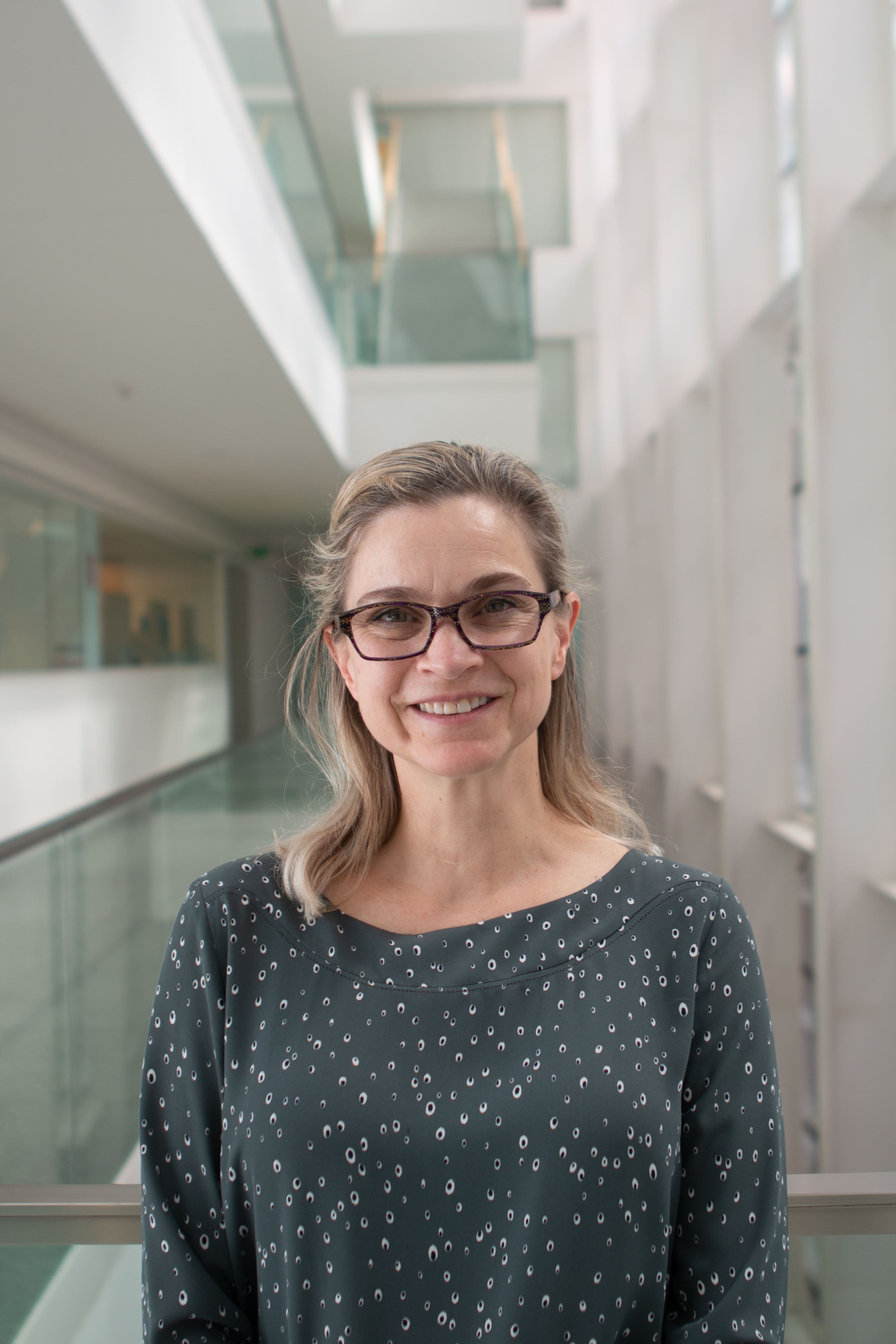
Since 2021, I have been a full-time research professor (investigadora) at Spain’s National Center for Research on Human Evolution (CENIEH). To move here, I left a position as a tenured, full professor of Integrative Biology at the University of California Berkeley, where I had been working up through the tenure track system since 2004. Prior to UC Berkeley, I was an assistant professor of Anthropology at the University of Illinois Urbana-Champaign (2000-2004). I was one of those incredibly fortunate souls who went straight from my PhD program at The Pennsylvania State University into a tenure-track position. But I did not go straight from my undergraduate program (University of Virginia, 1992) into a graduate program. I took four years to figure out how to become a scientist, living in and around Washington D.C.
What motivated you to pursue a career in biological anthropology?
I am fascinated by how people find their place in the world. This interest first expressed itself as a love of the theater. I was one of the “drama kids” in high school. In college, I was in the same dramatic arts program as Tina Fey, and quickly realized that I did not have what it would take to pursue the theater professionally. At the same time, I was taking an intro to 4-field anthropology course that completely drew me into the major. These days, the old classic ethnographies are shunned, but for me, they opened my eyes to how varied human culture is. I was amazed to learn that there were so many different ways to be human. My feminist anthropology course was similarly mind-blowing. I am pretty sure I never spoke during that class, just sat in the last desk by the window with my jaw agape the entire semester.
Gradually, I was drawn more to questions that could be answered empirically. At first, this was archaeology. But as I got towards the end of my undergraduate studies, I had a chance to go to the Koobi Fora Field School and fell in love with bioanthropological fieldwork. The only question that remained for me was whether I wanted to study living primates or paleoanthropology.
Please describe your early career path.
At the end of my undergraduate studies, I knew that I wanted to do research in biological anthropology, but I had no idea how to go about getting a PhD. During the four years I lived in the Washington, D.C., area, I took night courses in biology at a local college, volunteered every Friday in Noel Boaz’s lab at the Herndon campus of George Washington University, worked as a retail sales assistant, as a clerk at a law firm, an administrative assistant to an Illustrations Editor at National Geographic Magazine, and ultimately, as an intern at the Smithsonian’s National Museum of Natural History.
While at National Geographic, Tim White came through to talk with the editors about a potential article on the recently-discovered Ardipithecus. One of the editors kindly introduced us, telling Tim that I was interested in going to graduate school to study human evolution. Like me, Tim was from a rural area and knew nothing about academia when he started out. As a professor at Berkeley, he would give two lectures in his osteology course about how to apply to graduate school. He very kindly sent me cassette tapes of those lectures (yes, this was that long ago), which was exactly the help I needed to successfully find the best PhD program-fit for me. Once I visited Penn State and met Alan Walker and Pat Shipman, I knew this was the ideal academic home for me. I had a wonderful experience in my PhD program, for which I will be eternally grateful.
Who have been your most influential mentors?
My career has been influenced significantly by people who were incredibly generous and supportive, and almost equally shaped by people who were vicious and vindictive. Consequently, people have influenced me with behaviors that I want to emulate and behaviors I want to avoid. I have grown and changed over the decades of my career. I cringe at some of my early mis-steps but hope that over the years I have been increasingly successful at emulating the positive characteristics more than the negative ones.
The biggest piece of advice no one ever stated explicitly, but that I have gleaned from watching people over the years is: do the science because you sincerely want to know the answer. Any other reason will compromise it, and you.
Other more specific traits that I try to emulate and from whom I first learned them:
- Alan Walker: be intellectually fearless, as this is where new ideas are generated. Be intellectually generous, as ideas are a dime-a-dozen, share them.
- Tim White: Push back against racism, give proper credit, and use your privilege to uplift those who do not have it.
- Michael Mahaney: Collaboration is the key to truly transdisciplinary research. Embrace the challenge, humility, and grace that it requires.
- Gen Suwa: Rigor. My goal is to run my projects as if Gen were going to take them over from me. I fail at achieving anywhere near Gen’s level of rigor and organization, but it is my ideal.
- Nina Jablonski: Professional grace and the bravery to take big leaps of faith.
There are so many people who have been incredibly kind to me, who provided essential opportunities and advice over the years. To elaborate a bit more, Alan Walker boosted my intellectual self-confidence by giving me opportunities to push myself. Pat Shipman has always been my cheerleader and a sympathetic shoulder. Ken Weiss blew my mind by introducing me to developmental biology. He then suggested the idea, and took me to the Southwest National Primate Research Center to get the baboon quantitative genetics project started; this was a wild, outside-the-box idea at the time. Berhane Asfaw invited me to do fieldwork with the Middle Awash Project in Ethiopia where I learned to conduct paleoanthropological field work at the highest level of competency and rigor (he has also given me some of the best parenting advice ever). Stan Ambrose invited me to co-direct the field work at the Late Miocene site of Lemudong’o (Kenya) straight out of graduate school. Who does that? I am so grateful that he did. David Kyule generously and thoughtfully connected me with Sarah Kigamwa Amugongo, my first PhD student. Both of them left an indelible and inspirational mark on me. Steve Leigh modeled how to graciously listen to colleagues and course-correct in order to be more inclusive. Steve has had my back at several key times in my career, most recently encouraging me into leadership at AABA when I didn’t see the potential in myself. I also want to mention Clark Larsen and Owen Lovejoy, who have supported my research career in very meaningful but invisible, behind-the-scenes ways. They model how to take every opportunity to support deserving younger colleagues, even though the recipients will likely never know it. It is like being in a secret society. I really enjoy this part of being a senior scientist.
This list leaves out way too many people, especially those who I crossed paths with more recently. One thing that stands out is how few women are on my list. I love that BAWMN is fixing this for younger generations.
What were your most formative training experiences?
Thinking about the aim of BAWMN, I have one that I really want to share. The first time I was ever in a room of power led by a woman, that had a majority of women sitting around the table, was an NSF Biological Anthropology grant review panel when Kaye Reed was the Program Officer. This was a totally new experience for me, and I acted embarrassingly giddy the whole time. I LOVED that experience and learned so much from it. This is also one of the many reasons I love working at CENIEH, as Dr. María Martinón Torres is the director. It is so inspirational to watch women be brilliant leaders.
What is your subspecialty and how did you choose it?
I first fell in love with the thrill and challenge of finding new fossils in the field. Being the first person in the entire world to see a fossil and recognize what it can tell you about the past is such a dopamine-hit. But I am also in awe of how the genome and developmental processes make organisms and lead to variation between them. In graduate school I decided that I wanted to combine these two research areas. I use genetic approaches to figure out how to quantify skeletal variation according to the underlying genetic influences. I then apply this to the fossil record in order to elucidate the paleobiology of long-dead species.
How do you balance the competing priorities of teaching, research, outreach, and personal life?
I started on an R1 academic track. Originally, I believed this to be a meritocracy. After being harassed for many years by another departmental faculty member at UC Berkeley, and watching all of my colleagues tacitly or explicitly condone this behavior, I grew very disillusioned. Increasingly, it became clear that there was never going to be a positive work culture for me outside of my lab group at Berkeley. And so, I decided I had to go. My goal was to move into a position where I could be happy and also help change the culture of academia, or at least not have a pit of anxiety in my stomach every day that I went into work. The full-time research position at CENIEH offered an opportunity I never even imagined existed. While I no longer teach, I can be a source of change by dedicating time to association and editorial leadership.
Which professional achievements are you most proud of?
Let me provide a little background before directly answering this question. Since graduate school, I have repeatedly been advised to do as little academic service work as possible in order to focus on research. This advice never sat right for me, and I struggled with the perception that these two things are mutually exclusive. I have long found service work to be a positive refuge from the nastiness of academia.
In 2022, I won two awards that, combined, demonstrate this advice to be misdirected. I was awarded the Gabriel W. Lasker prize in recognition of my service to AABA as Vice President and Program Chair, developing from scratch the virtual annual conference in 2021 and the hybrid conference in 2022. The same month, I won a 5-year 2.5-million-Euro Advanced Grant from the European Union’s European Research Council to pursue my research dream. Both of these are incredibly prestigious awards. To me, the simultaneity of the recognitions felt like the ultimate validation. Service to the community does not have to be a choice away from scientific excellence, and vice versa.
In your opinion, what are the biggest challenges facing women in the biological anthropology community today?
There has been so much positive change over the course of my career. When I started out, women had to be more like men. We had to down-play femininity and personal lives in order to succeed. For a decade, I wouldn’t wear a skirt to work, and I still struggle with the color pink. I gave up a lot of myself and learned to tolerate a lot of the papercuts of misogyny in order to obtain and keep my seat at the table. A part of me is not proud of this, but another side of me is, as I know that I wouldn’t be here today, answering these questions for BAWMN had I not jumped through all those hoops.
I deeply appreciate that, as years went by, I could increasingly be myself. These days, I can bring in baked goods for colleagues and talk about having a daughter without feeling judged. I love this.
I hope that we keep celebrating the new-found humanity in our discipline so that our perceptions of prestige and gravitas increasingly include characteristics that are typically seen as more feminine.
What advice would you offer women in biological anthropology beginning their scientific careers?
Towards the end of my years at Berkeley, I felt an incredible amount of pressure to give every ounce of my existence to the job. I felt as though the world was turning to me to personally fix all the problems for everyone all at once. But, obviously, if you try to do everything, you end up doing nothing meaningful. And your soul is drained. My advice is to focus, to identify a few core things you are good at, that you find fulfillment in doing, and that make the world a better place. Don’t feel pressured to fix everything. Imagine how much kinder the world would be if everyone had just one make-the-world-better mission added to their research aim.
What attracted you to BAWMN and what does participating in BAWMN mean to you?
I have been a recipient of BAWMN’s generosity over the years. At one of my early low-points at UC Berkeley, I signed up for a couple of BAWMN mid-career mentoring workshops. With incredible luck, I was paired up with Michelle Bezanson. She kindly and objectively gave me the practical advice I needed to hear. Her words still resonate in my mind to this day. That same workshop, a senior colleague made a point of acknowledging the unfairness of my situation at Berkeley. It is very healing to have your mistreatment seen and acknowledged by a senior objective observer. Thank you BAWMN, for all of the good you have done, for so many women over the years.
 Biological Anthropology Women's Mentoring Network