Kaye Reed
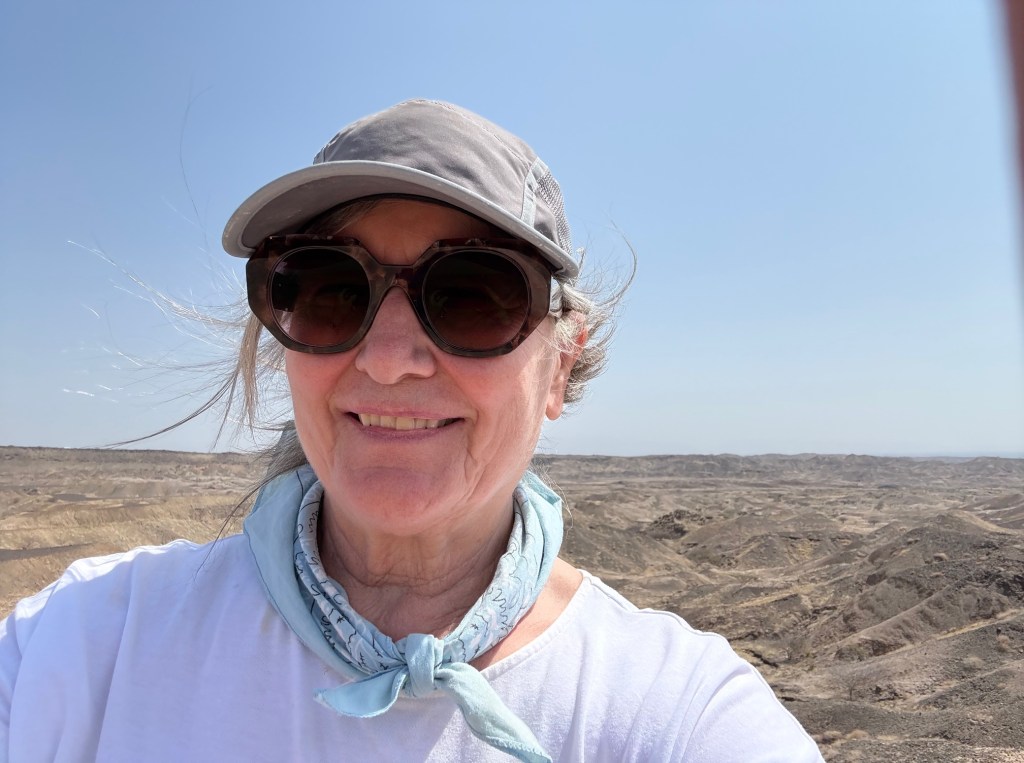
What positions do you currently hold?
I am currently President’s Professor Emerita at Arizona State University, a Research
Scientist at the Institute of Human Origins (IHO), and a Board Member at IHO.
What is your educational background?
I received my BS in Anthropology from Portland State University in 1989 and my MA
(1994) and PhD (1996) in Anthropological Sciences from Stony Brook University.
Professor John Fleagle was my advisor.
What motivated you to pursue a career in biological anthropology?
I had a non-traditional career path. After high school I tried college, and at that time it
wasn’t for me. I had my son in 1971 then worked at a publishing company and a
computer software business for about 14 years until I decided to go back to school to
major in English. At Portland State, three classes in the social sciences were required,
and I decided to take them in anthropology. The first was cultural anthropology and the
second, “physical” anthropology. I thought that biological anthropology was the greatest
subject ever and changed my major to anthropology. I went to my professor Marc
Feldesman’s office one day to pick up a paper. He said it was a very good paper and
asked me what I was doing with my life. I said that I was going to graduate school. I had
not thought about that until that moment, but I somehow knew it was the right path for
me. So, in the long run, I owe the most fun part of my life to Marc, who was a great
professor, motivating me to do well—even though one of my first papers had a comment
that said, “confused and confusing.” He also helped me figure out where to attend grad
school.
Please describe your early career path.
At the AABA meetings in 1994, I asked Bill Kimbel if I could look at the Hadar fauna as
the first project after my dissertation, for which I was still collecting data in South Africa.
He kept asking me if I needed to go to the field (three times). I kept saying, no, museum
work was all that was required. I was thinking why does he keep asking me that, and he
was thinking, what is wrong with this woman (we discussed this later). In any case, I
was asked to go to the field at Hadar in the fall of 1994. While I had been to the field in
Argentina for a short time in grad school, the extended time at Hadar was amazing, and
I knew then that I wanted to continue with field work in Africa. That led to me being
offered a postdoc at the Institute of Human Origins in Berkeley after I received my PhD.
In 1997, Geoff Clark from Arizona State University called Don Johanson and asked,
“Why don’t you move your institute here?” Don and Bill went to ASU and things were
looking good for a move. I was applying for jobs, but Don said that he had asked ASU
whether they could bring their postdoc. The Department of Anthropology asked me to
give a talk and then offered me a tenure track position!! I was in the right place at the
right time for both my postdoc and the assistant professorship.
After arriving at ASU in the fall of 1997, I began leading field schools to Makapansgat,
South Africa for undergraduates. From 1998 until 2004 there were 15 students per year,
many of whom went on to graduate school at ASU and elsewhere. In 2002—the year I
became an associate professor—I began research in the lower Awash Valley of Ethiopia
with my colleagues Charlie Lockwood and Ramon Arrowsmith, which eventually
became the Ledi-Geraru Research Project. So, in my early career, I was teaching four
classes a year, volunteering to teach a five-week field school in South Africa every
summer, and writing grants and planning field seasons in Ethiopia at Hadar and the
Ledi-Geraru. I was extremely lucky that I could juggle my teaching so that I could do
fieldwork in the fall.
Who have been your most influential mentors?
- Marc Feldesman, who introduced me to primate and human evolution, inspired me to read critically, and tried to get me to take my scatter-gun approach to writing and focus it into a single bullet.
- John Fleagle, my PhD advisor, is an outstanding primatologist, functional morphologist, and renaissance man, who motivated me to want to learn more on all topics and to think about the big picture before figuring out the specific questions to address.
- Judith Masters, who I had coffee with every afternoon for 18 months in South Africa. We discussed evolution, speciation, and biogeography. Judith expanded my mind, and I am forever grateful.
- Gerry Eck, who taught me how to do fieldwork and to identify ALL the mammals—not just monkeys and hominins. I am so happy for the time I spent in the field with him.
- Bill Kimbel, my postdoc advisor and colleague for 28 years, whose knowledge of hominin fossils (and their specific collection numbers!) helped me to understand the importance of knowing every detail about the fossil record.
- And a myriad of people who inspired me due to their work and/or discussions,
What were your most formative training experiences?
Learning anatomy, although I wasn’t terrific at it, was an essential skill for everything
that I have done in my career. Thanks, Jack Stern and Bill Jungers! Having John
Fleagle and Gerry Eck train me in looking for fossils at various times in my early career
was also foundational. Anatomy and field work helped me see that I was a hands-on
learner, and I consequently tried to make my teaching hands on.
What is your subspecialty and how did you choose it?
As an undergraduate, I became very interested in Neandertals and cranial shape and
size. I thought that is what I would work on for a PhD project. But in graduate school there were many professors at Stony Brook, and they covered many different research
areas. There were also people outside of anatomy and anthropology that were available
to work with. I took a class with Curtis Marean dealing with the paleoecology, climate,
and large mammal extinctions of North America, and I decided I wanted to examine
paleoecology for Miocene apes or early hominins. I did my “essay”—essentially a field
statement—on community ecology, structure, and mammals. I realized that Peter
Andrews had already explored the paleoecology of Miocene apes, so the context of
hominin evolution became my focus. I love mammals and studying them in the wild so
that I can use them as analogs to fossil critters.
How do you balance the competing priorities of teaching, research, outreach, and personal life?
In my early career I probably prioritized teaching as it was the most immediate
demand—if one doesn’t have a lecture ready, it is bad news. I also designed labs for
introductory biological anthropology in my early days, mostly because I wanted students
to have hands-on experiences learning about human evolution. My next priority was
research, followed by service. I don’t think my personal life suffered as I really tried to
take weekends off, whenever possible, to hike or do something calming. Now that I am
retired, the only thing that I don’t do is teach (yes, I found other service), but I have a lot
more personal time, which is nice.
Which professional achievements are you most proud of?
I am proud of putting together a field team and finding important fossils in the Ledi-
Geraru of Ethiopia, especially as a woman in a traditionally male-dominated field.
Additionally, I am proud of the service I did at the National Science Foundation and of
being Director of the School of Human Evolution and Social Change for four years. And
I am particularly ecstatic and proud for the success of my students.
In your opinion, what are the biggest challenges facing women in the biological anthropology community today?
I think it is getting better, but although there are many women getting PhDs in
anthropology, the jobs still disproportionately go to men. Networks such as BA WMN are
helpful in strategizing ways to eliminate that bias. Women need to call out gender bias
when they see it—whether one is the applicant or in a department where a woman
applicant was the better choice. Life is harder for women in academia on many levels.
What advice would you offer women in biological anthropology beginning their scientific careers?
Most importantly, do what you want to do most of the time. Yes, you have to do the
three pillars, but take joy in the aspects that you love and give them a little extra
attention. Be strong and stand up for what is right in meetings and in interactions with
others. It is hard for women to be strong in our patriarchal society (STILL), but we all
must give it our best shot.
What attracted you to BAWMN and what does participating in BAWMN mean to you?
I love BAWMN. My favorite part of it is the networking and mentorship. I have met so
It is important that women support each other and work out problems together—not
necessarily only research problems, but also those of administration, bad actors, and
the other myriad issues that arise in academia (or elsewhere). We all need to talk about
difficult issues and hope that others in the group have ideas to address problems, from
low salaries to using only research to justify tenure, as two examples. I have been
involved in a few BA WMN workshops because I have had this career for 36 years, and
I hope to be able to help others arrive at solutions to problems that I have previously
faced.tors is super important, and
BAWMN can be a key part of that.
Please click on the links below to view our previous featured member profiles:
If you are a member of BAWMN and would like to nominate yourself or a colleague to be featured, please contact BAWMN. There are no restrictions on career stage, subfield, or institutional affiliation of nominees.
 Biological Anthropology Women's Mentoring Network